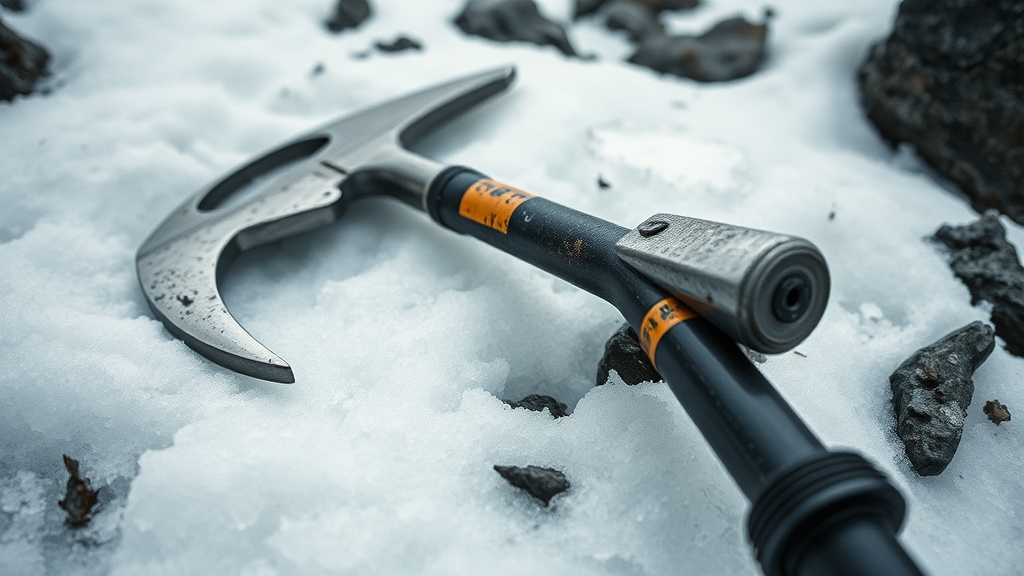
Spring Ice: Why Your Axe's Warranty Means Nothing at 2000 Feet

Let's talk about the axe that almost didn't come home.
Not a dramatic story — that's the point. A climber on the North Cascades approach, maybe 2,200 feet, firm morning névé transitioning to wet slush by 10am. Standard spring conditions. He swung the axe to self-arrest a slip that didn't turn into a fall, and the pick flexed. Didn't shear. Didn't obviously fail. Just moved wrong, like a tooth that's loose in the gum. He finished the climb. He filed no incident report. The axe is probably still in his garage.
That's the version of ice axe failure SAR teams rarely document — the near-miss where the climber chalked it up to bad technique instead of compromised equipment. The documented version is worse.
Spring ice is not a forgiving evaluator.
Spring Ice Is A Different Discipline
I want to be precise here, because "it's spring, be careful" is the kind of advice that sounds useful and accomplishes nothing.
What actually changes in spring climbing conditions is the freeze-thaw cycle acting on both the terrain and your equipment simultaneously. The Cascades run overnight temps in the low 20s°F transitioning to daytime highs above freezing from roughly mid-March through May. That's not a weather inconvenience — that's a material fatigue accelerant.
Ice itself changes character: morning névé is dense, well-bonded, and holds a pick placement cleanly. By early afternoon on a sun-exposed face, that same slope is isothermal slush with a fragile crust. The mechanics of an ice axe placement that worked at 7am are different from the ones you'll need at noon. But climbers rarely adjust technique or inspect gear mid-day. They're tired, they're moving, and the axe has been "working fine."
Mixed terrain exposure adds another variable. Spring routes in the Cascades frequently transition between ice, firm snow, and rock. Every time you cross-use an ice tool on a rock stub or a frozen debris field, you're introducing microcracking stress to the pick geometry that no certification test replicates.
The UIAA 152 standard for ice axes tests static load, not cumulative fatigue under cyclic mixed-use conditions. That's not a knock on the standard — it tests what it can test. But from what I've seen in field incident patterns, real-world failure modes don't respect lab parameters.
The Warranty Lie (Which Starts With Certification)
Here's the industry reality no manufacturer marketing department wants you to think about: quality assurance testing and field failure analysis are not the same thing.
Manufacturer proof testing typically involves a single destructive load event: apply force to a static fixture, record the result, pass or fail. What it doesn't model is the cumulative stress history of an axe that's been swung two hundred times on Glacier Peak, stored wet in a truck bed, used on six rock-ice mixed pitches, and never inspected for fatigue indicators because it "looked fine."
Aluminum fatigue is particularly treacherous — and I want to be clear this is my read from industrial design background and field observation, not lab metallurgy — because it doesn't announce itself the way steel typically does. Steel tends to deform visibly before fracture. My understanding of how the aluminum alloys common in quality ice tools behave is that they can cycle within elastic limits for a long time before failing, without giving you warning proportional to the risk. The 6061-T6 and 7075-T6 alloys are well-characterized in engineering literature, but those characterizations assume controlled loading geometry. Mixed-use real-world climbing doesn't give you controlled loading geometry.
What no manufacturer is eager to say is that low-frequency field failure modes almost certainly exist across product lines for years before reports cluster enough to trigger formal action. That's not necessarily malfeasance — it's the math of low-probability, high-consequence field failures. The warranty means the manufacturer will replace a broken tool. It says nothing about what happens in the field before the tool breaks.
Three Failure Patterns SAR Teams Actually See
I'm going to describe these in terms of what you'd observe on a recovered axe, because that's how I've learned to read them. These are patterns — composites from incident reports and field observations, not single events. If you want to calibrate against documented data rather than my field read, the AAC accident report archives and the NPS annual mountaineering statistics are where that evidence lives.
Pick shear at the haft junction. The pick is mechanically attached to the head, and the head is either welded, pinned, or monolithically cast with the shaft. On modular tools, the pick-to-head attachment point is the stress concentration site. Cyclic mixed-use loading — especially plunging into a rock-ice interface or prying out a stuck placement — introduces bending moment at that junction outside its design axis. You typically won't see this failure building. The pick will be solidly attached until it isn't.
Shaft fatigue at the ergonomic bend. Many modern ice axes have a curved or kinked shaft profile to clear crampon placements and reduce wrist stress. That geometry creates a stress concentration in the shaft material. On shafts that have been used across multiple seasons, especially tools with hollow shaft construction, this zone can develop internal fatigue cracking that doesn't show through the anodizing. The diagnostic is shaft flex — I'll cover the field test below.
Spike degradation and socket loosening. The spike is the most under-inspected component on most ice axes. On composite shaft tools, the spike is pressed or epoxied into the shaft bottom. Repeated self-arrest drag across rock and frozen debris wears the spike geometry and works the socket interface. The failure mode here isn't typically dramatic spike fracture — it's spike rotation under load during a self-arrest, which degrades the arrest quality at exactly the moment you need it most. I've pulled axes from SAR recoveries where the spike had rotated twenty degrees in its socket. The climber would never have noticed on flat terrain.
None of these three failure modes are detectable by looking at the axe hanging on a gear wall. All three are detectable with a pre-climb physical inspection.
The 5-Minute Pre-Climb Audit
This is not an annual maintenance checklist. This is what you do in the parking lot, every time, before a spring climb. It takes five minutes. It catches most of what's going to matter.
Shaft flex test. Hold the axe at the head and at the spike end. Apply moderate flex load — you're not trying to break it, you're feeling for uniformity. A sound shaft will flex evenly along its length. A shaft with internal fatigue cracking will have a soft spot: a zone where flex is noticeably easier than the adjacent material. If you find a soft spot, retire the shaft immediately. If you don't know what a healthy flex feels like, do this with a new or known-good tool first to calibrate your hands.
Spike tap test. Hold the axe with the spike pointing away from you and tap the spike firmly against your palm, then against a hard surface. You're listening for two things: a solid resonant tap (good) versus a dull thud or rattling (socket loosening or epoxy failure). Then grip the spike firmly and try to rotate it against the shaft. It should not move. Any rotation under hand force means the socket integrity is compromised.
Pick-strike inspection. In good light, examine the pick face at 2–3x magnification if you have it, naked eye if you don't. You're looking for lateral cracks — lines running perpendicular to the pick edge, typically at tooth roots or at the pick-to-head junction. Linear wear on the pick teeth is normal and expected. Transverse cracks are a different category. Also check the pick-to-head attachment torque if your tool has threaded picks — they back out under vibration, and a loose pick under load is not a pick you want.
Head/shaft junction visual. On bonded or composite construction, check the junction zone for stress whitening, cracking, or epoxy gap. Anodizing conceals a lot, but stress fractures in the material beneath often telegraph through the coating as hairline surface cracks that follow the fracture path. A flashlight at a shallow angle helps.
Leash attachment points. Not a failure mode I've listed above, but worth noting: leash holes and carabiner attachment loops on the head are another stress concentration site. Any crack propagating from an attachment point hole is a retirement indicator.
The Gap Between March Gear and March Conditions
Here's where I'll be direct about something that the certification framework doesn't address.
Most climbers are using tools that are two, three, or five seasons old. They bought them certified, they've been using them without incident, and they're planning a spring climb. The axe isn't broken. The warranty is still technically in effect. Nothing has obviously failed.
But spring conditions — specifically the temperature swing, the mixed terrain, and the increased volume of use that comes with the beginning of the season — are when accumulated fatigue stress becomes visible. The tool that held up fine on winter hard ice may have a shaft that's cycled close to its fatigue limit by the time March ice conditions put a specific geometry of load on it.
Certifications are issued to a tool in a specific state. They don't travel forward through the tool's use history. The warranty covers manufacturing defects. Neither of them have anything to say about what happens at 2000 feet when the névé goes wet and you swing into a rock seam.
The pre-climb audit is the only instrument you have that's calibrated to your actual tool, in its actual condition, today.
What I Actually Do
I own three ice axes. I inspect them before every alpine route regardless of what we're doing. I've retired two tools in the last four years based on shaft flex anomalies I couldn't attribute to manufacturing variation — tools I'd used hard, and I couldn't convince myself the flex was normal. Neither of them failed visibly. I retired them because I couldn't trust them, and the cost of being wrong was a body recovery.
The audit takes five minutes. That's not a meaningful trade against what spring ice can do.
Check your gear before it checks you.
For documented field failure patterns: the AAC maintains public accident report archives, and the NPS publishes annual mountaineering statistics. Both are publicly available and better calibration than anything a gear marketing department will tell you.