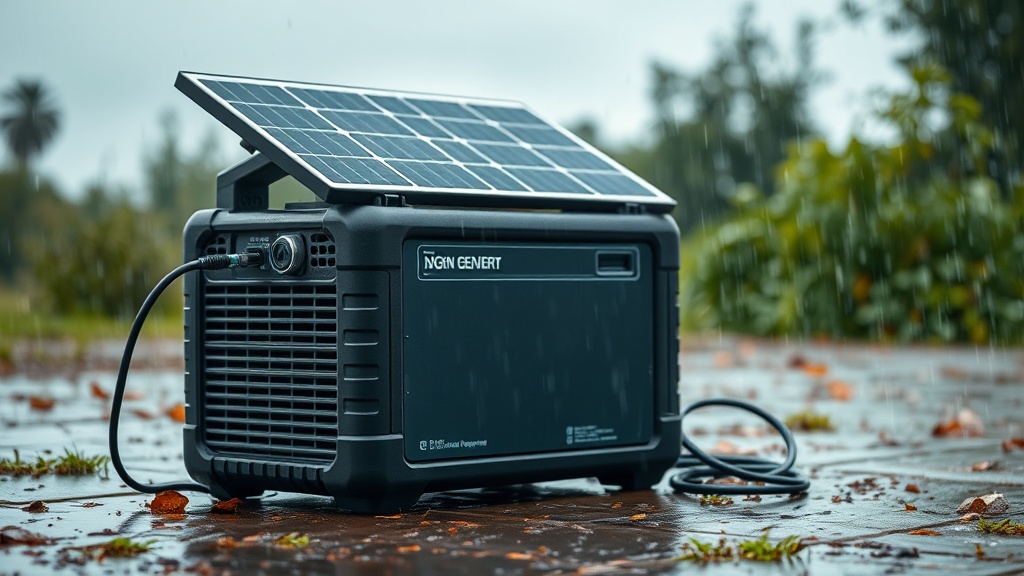
Which Solar Generator Actually Holds a Charge in the Rain?

Is Your Portable Power Station Just an Expensive Paperweight?
Can you actually rely on a lithium battery to keep your gear running when the weather turns sour and the sun disappears for three days? This is the question that separates weekend campers from people who actually live off-grid. Most marketing materials focus on how much power a unit can pump out during a sunny afternoon, but they rarely talk about how that capacity holds up during a week of heavy cloud cover or high humidity. We're looking at the technical reality of portable power—specifically how internal resistance, temperature, and discharge rates affect your actual usable wattage when things go wrong.
When you're living out of a van or a remote basecamp, your power station isn't just a luxury; it's your lifeline. If your laptop dies while you're working remotely, or your navigation tablet fails during a storm, the cost isn't just the hardware—it's your ability to function. We need to look past the "Wh" (Watt-hour) rating and look at the efficiency of the conversion process.
Why Does Solar Charging Slow Down in Cloudy Weather?
Most people assume that if a cloud passes over, the charging stops. In reality, it's much more complex. Solar panels rely on photon absorption, and even under heavy cloud cover, a significant amount of diffuse radiation reaches the cells. However, the voltage drops significantly. If your charge controller isn't efficient enough to handle that lower voltage, the power won't even make it to your battery. This is where cheap, unbranded solar kits fail—they can't manage the fluctuating input from a changing sky.
Standard monocrystalline panels are the industry standard for a reason. They handle low-light conditions better than older polycrystalline models, but even then, you're looking at a massive drop in efficiency. To understand the technical side of solar input, you can check out the latest research from the National Renewable Energy Laboratory (NREL) regarding solar irradiance and efficiency. It becomes clear that the hardware's ability to capture light is only half the battle; the other half is the battery's ability to accept that irregular trickle of power.
Does Temperature Affect Battery Capacity?
A common mistake is assuming a 1000Wh battery will always provide 1000Wh of energy. It won't. Lithium-ion and LiFePO4 (Lithium Iron Phosphate) batteries are highly sensitive to thermal environments. In extreme cold, the internal resistance of the battery rises, which means the chemical reaction required to move electrons slows down. You might see a full charge on your display, but the moment you plug in a high-draw device like a portable fridge, the voltage drops sharply, and the unit shuts down.
I've seen countless people buy high-capacity power stations only to find them useless during a cold snap in the high desert. If you're planning to use your gear in sub-zero temperatures, you need to look for units with integrated heating elements or, at the very least, understand that your usable capacity will drop by 20% to 40%. This isn't a defect; it's physics. For a deeper dive into how battery chemistry behaves in different climates, the technical documentation from Battery University is the gold standard for understanding these limitations.
How to Choose the Right Capacity for Your Setup
Stop looking at the total Watt-hours and start calculating your "Daily Load Profile." This is the only way to determine true value. If you need 500Wh of power per day to run your lights, a phone, and a small fan, a 1000Wh battery might seem like a safe bet. But if you factor in a 20% efficiency loss during AC/DC conversion and a 30% reduction in solar input due to weather, that 1000Wh battery might only provide about 600Wh of actual usable energy. You're cutting it way too close.
Here is a breakdown of how to calculate your real-world needs:
- Step 1: List every device and its average wattage.
- Step 2:
Multiply wattage by hours of use per day.- Step 3:
Add a 25% "Safety Buffer" for conversion loss (especially if using an inverter).- Step 4:
Divide your total by the expected solar input efficiency (usually 0.5 for cloudy areas).
Let's look at a typical comparison of a high-end unit versus a budget unit in a real-world scenario:
| Feature | Budget Unit (Generic) | Premium Unit (Brand Name) |
|---|---|---|
| Battery Chemistry | Lithium-ion | LiFePO4 (Longer life) |
| Inverter Efficiency | ~80% | ~90% + |
| Charge Controller | Basic PWM | MPPT (More efficient) |
| Cost-per-Watt-Hour | Lower upfront cost | Higher upfront, lower long-term cost |
The goal isn't to buy the biggest battery. The goal is to buy the one that can actually deliver the power you need when the conditions aren't perfect. A smaller, highly efficient MPPT-controlled system will often outperform a massive, poorly regulated one in a real-world, low-light environment. Don't be fooled by the big numbers on the box; look at the efficiency of the delivery system. That is where the real value lies.