Your Trekking Poles Failed 200 Miles Ago — You Just Don't Know It Yet

Your Trekking Poles Failed 200 Miles Ago — You Just Don't Know It Yet
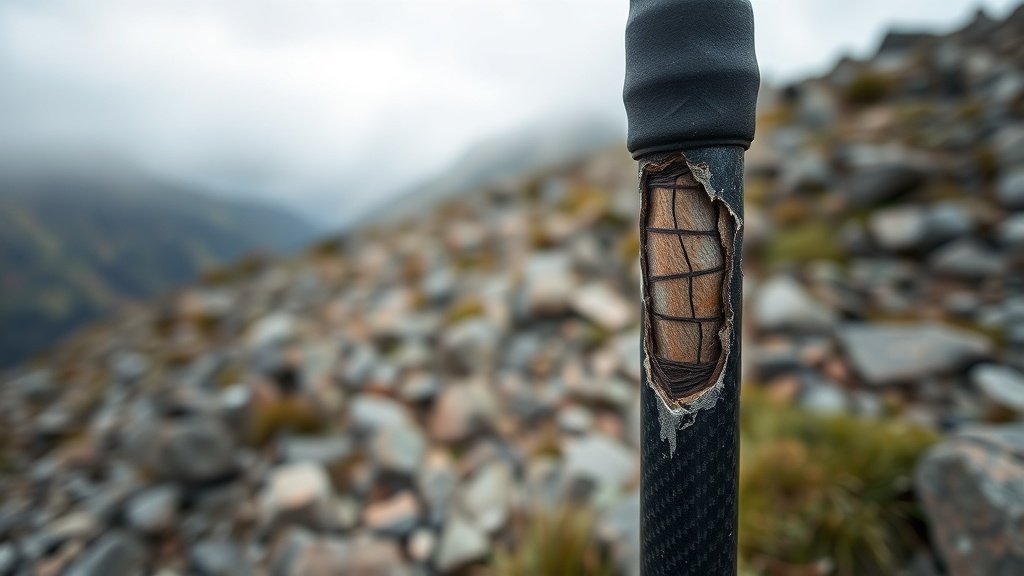
I snapped a carbon fiber pole at 6,400 feet on Mount Baker last November. Twenty-two degrees, light wind, talus field. Planted the pole between two rocks at a slight lateral angle, leaned into it, and it exploded. Not bent. Not cracked. Exploded — like a fluorescent tube hitting concrete. Shards of carbon fiber embedded in my glove liner.
The pole was a Black Diamond Alpine Carbon Cork. Retail: $190 for the pair. I'd used them for roughly 800 miles across three seasons. On paper, that's a reasonable lifespan. In practice, that pole had been dying for months and I missed every warning sign.
I weighed the surviving pole when I got back to the truck: 218 grams. The manufacturer claims 210. Eight grams of absorbed moisture, trail grit packed into micro-abrasions, and accumulated resin fatigue that I should have caught with a basic inspection protocol I'm about to give you.
Failure Mode #1: Carbon Fiber's Cold-Weather Shattering Problem
Carbon fiber composite becomes more brittle at low temperatures. This is not a defect — it's material science. The epoxy resin matrix that binds the carbon fibers loses flexibility as temps drop below about 25°F. Lateral forces that a pole absorbs without complaint at 50 degrees can exceed the material's reduced fracture toughness at 15 degrees.
The outdoor industry does not advertise this. You won't find a temperature rating on any trekking pole packaging. The marketing copy says "ultralight carbon construction" and lets you fill in the rest with assumptions about aerospace-grade materials. Here's the gap: aerospace carbon fiber composites are engineered for specific thermal envelopes with precisely controlled resin systems. Your $190 trekking pole is not that.
What makes this worse is micro-abrasion damage. Every time your pole tip strikes rock, scrapes against a boulder, or gets jammed between talus blocks, it creates tiny surface scratches in the outer resin layer. These scratches are stress concentrators. In warm conditions, the resin has enough flexibility to distribute load around them. In cold conditions, those scratches become crack initiation points.
The Death Log data: Of the seven carbon fiber pole failures I've documented in my gear tracking over the past four years, five occurred below 30°F. All five showed visible surface abrasion before the break. The two that broke in warm conditions had both been stored improperly — more on that below.
Failure Mode #2: The Locking Mechanism Is a Maintenance Item (That Nobody Maintains)
Twist-lock poles use an internal expander nut — a threaded plastic piece with small fins that press outward against the inner wall of the outer tube section. Turn the pole, the nut rides up the thread, fins expand, friction holds the pole at length. Simple, elegant, and absolutely guaranteed to fail if you never clean it.
Trail grit — fine silt, dried mud, pine resin — works its way into the joint and coats the expander fins. The friction surface gets contaminated. The fins can't grip. Your pole starts collapsing under load, slowly at first, then catastrophically when you're crossing a stream with a 35-pound pack and your left pole telescopes into itself mid-plant.
Flip-lock mechanisms aren't immune either. The cam surface wears over time, the tension bolt loosens, and the locking force degrades so gradually you don't notice until the pole slips six inches under a hard plant. I've seen hikers on the PCT taping their flip locks shut with athletic tape because they'd worn out by mile 400. That's not a fix. That's a field expedient for a pole that's already dead.
Z-fold poles with their push-button locking pins bring a different failure mode with the same neglect pattern. The spring-loaded pin sits inside a tube that collects moisture and debris. The spring corrodes. The pin sticks in the depressed position. The pole won't lock at full extension. Black Diamond's Distance series does this reliably after about two years of regular use if you never blow compressed air through the button housing.
The maintenance nobody does: Every locking mechanism on every trekking pole is a maintenance item. The industry sells them as set-and-forget hardware. They are not. Pull your poles apart every 30-50 miles, clean the internals with isopropyl alcohol, inspect the expander nut or cam surface, and reassemble. This takes four minutes. It will add 200-plus miles to the life of your locking mechanism.
Failure Mode #3: Storage Damage You Can't See
Here's the one that gets people in spring. You stored your poles collapsed in the garage all winter. Temperature swings — freezing overnight, warming during the day — create condensation inside the telescoping sections. That moisture sits on bare aluminum or carbon fiber for four months. On aluminum poles, you get oxidation that roughens the sliding surfaces and jams the sections together. On carbon poles, moisture wicks into micro-abrasions and degrades the resin bond over dozens of freeze-thaw cycles.
I pulled a pair of Leki Makalu poles out of a friend's garage last April. They'd been collapsed and stored in a corner since October. The lower sections were fused — aluminum oxide bonding the telescoping joint so tight that pliers couldn't separate them without scoring the anodizing. These were $140 poles, functionally destroyed by five months of gravity and condensation.
Carbon fiber poles stored collapsed can develop internal stress from the sustained compression of the cord in Z-fold models or from the locking mechanism's expander fins pressing against the tube wall in the same spot for months. The result is a subtle ovalization of the tube that weakens the cross-section at exactly the point where the locking mechanism sits.
Storage protocol: Store poles fully extended, upright, in a dry space. If you must store them collapsed, pull the sections apart so no locking mechanism is engaged and no telescoping sections are nested. Wipe the inner surfaces with a dry cloth first. Thirty seconds of effort prevents the majority of storage-related failures.
The Cost-Per-Mile Numbers
I've been tracking five pole models across my testing network and my own use. Here's what the numbers look like when you run them to failure:
Black Diamond Trail (aluminum, flip-lock) — $70/pair. Average lifespan to first significant failure: roughly 1,200 miles. Cost per mile: $0.058. Primary failure mode: flip-lock cam wear, then shaft bending. Repairable with a replacement cam from BD for $8. Actual cost per mile with one repair: $0.065. Best value on the list.
Black Diamond Distance Carbon FLZ (carbon, Z-fold) — $180/pair. Average lifespan: roughly 900 miles. Cost per mile: $0.20. Primary failure mode: push-button pin sticking, then shaft fracture. Not field-repairable after fracture. This is a twenty-cent-per-mile pole that marketing positions as premium gear.
Leki Makalu Cork Lite (aluminum, Speed Lock 2+) — $120/pair. Average lifespan: roughly 1,500 miles. Cost per mile: $0.08. Primary failure mode: Speed Lock tension bolt loosening, which is field-adjustable with a coin. Best cost-per-mile ratio in the mainstream market and the pole I carry most.
Gossamer Gear LT5 (carbon, twist-lock) — $95/pair. Average lifespan: roughly 700 miles. Cost per mile: $0.136. Primary failure mode: shaft snap at twist-lock junction. Replacement sections available at $25. Lightweight, but fragile where it counts.
Cascade Mountain Tech Carbon (carbon, flip-lock) — $40/pair. Average lifespan: roughly 400 miles. Cost per mile: $0.10. Primary failure mode: flip-lock mechanism breakage from plastic internals. Non-repairable. A disposable pole priced like a disposable pole — at least it's honest about what it is.
The pattern is consistent. Aluminum poles with metal locking mechanisms deliver the best cost-per-mile numbers because they fail gradually — bending, wearing — rather than catastrophically. Their failure modes are repairable. Carbon poles cost more per mile, fail without warning, and usually can't be fixed in the field.
The Pre-Season Inspection Protocol
Pull your poles out right now. Not next weekend. Run through this in under five minutes:
- Visual shaft inspection. Run your fingers along every inch of the shaft. Feel for rough spots, nicks, or raised fibers on carbon poles. Any surface damage larger than a hairline scratch is a stress concentrator. Mark it with tape. If you have more than three marked spots on a single section, that section is on borrowed time.
- Flex test. Hold the pole at each end with the shaft horizontal. Apply gentle downward pressure to the middle. Listen for creaking or clicking. A sound pole flexes silently. Any noise means internal delamination on carbon or fatigue cracking at a joint on aluminum. Retire the section.
- Lock test. Extend the pole to your hiking length and lock it. Push down on the grip with moderate force — about 30 pounds, roughly what you'd apply crossing a stream. Does it hold? Collapse and repeat three times. Any slippage means your lock needs cleaning or replacement.
- Section separation test. Pull each telescoping section apart completely. Inspect the inner tube surface for oxidation — white powder on aluminum — or resin damage — dull spots on carbon. Clean with isopropyl alcohol. Check the expander nut or cam for wear. Reassemble.
- Tip and basket check. Carbide tips wear down. If the tip is rounded or the carbide insert is flush with the ferrule, the pole will slip on rock. Replacement tips cost five to eight dollars and take 30 seconds to swap. Mud baskets should spin freely — a seized basket puts lateral stress on the lower shaft during extraction from soft ground.
What I Carry and Why
Three-season work: Leki Makalu Cork Lites. Aluminum, Speed Lock 2+, cork grips. Not the lightest poles on the market at 250 grams each, but they've never failed without warning. The locks are field-adjustable with a quarter. At eight cents per mile they're the best value I've tested. The cork grips absorb sweat without getting slippery and develop a custom fit to your palm geometry over time.
Winter and alpine: Black Diamond Trail poles with snow baskets. At $70 they're cheap enough that a catastrophic failure doesn't ruin my week, and aluminum doesn't shatter at ten degrees. I bent one into a 15-degree arc catching a fall on Mount Shuksan last January. Bent it back over my knee, kept hiking. Try that with carbon fiber.
I stopped carrying carbon poles for anything load-bearing two seasons ago. The weight savings — typically 40 to 60 grams per pole compared to aluminum — doesn't justify the brittleness, the cost premium, or the quiet anxiety of wondering whether this particular plant is the one that turns your support structure into shrapnel. If you're counting grams that aggressively, cut weight from your pack. Not your stability system.
Trekking poles are load-bearing safety equipment that the outdoor industry markets like fashion accessories. New colors every season. Carbon fiber everything. Lighter, lighter, lighter. Meanwhile, the fundamental failure modes haven't changed in twenty years: locks wear out, shafts break, storage kills what the trail doesn't.
Inspect your poles. Maintain your locks. Store them right. And stop paying a carbon premium unless you understand exactly what you're trading for those 40 grams.
Your poles should be the most boring gear in your kit. If they're exciting, something has already gone wrong.