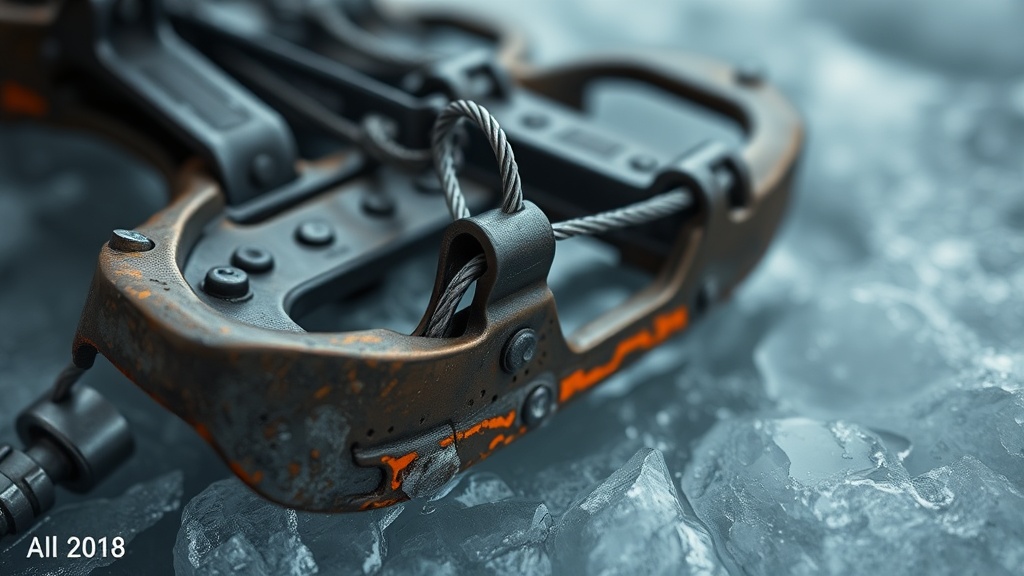
Crampon Bail Failure in Spring: The Freeze-Thaw Gap Your Certification Doesn't Cover

Let's talk about the gear failure that happens before you even rope up.
I've assisted with three evacuations in the North Cascades over the last six years. Two involved crampons. Neither pair had obviously failed. No visible cracks, no missing hardware, no loose bails. Both pairs had been used "just a season or two." Both passed a quick visual before the approach. When I examined both pairs afterward, the failure mode in each case appeared consistent with progressive bail distortion — the kind that accumulates under repeated wet-freeze cycling. I can't prove that's what happened without destructive testing. What I can say is that nothing else explained what I saw, and the mechanism is well-established in fatigue materials science.
That's spring climbing. That's what March and April do to your gear. If you haven't explored how spring ice conditions compromise equipment across multiple systems, start there.
Spring Ice Is a Different Material Problem
Most climbers buy crampons thinking about one condition: cold, dry, hard water ice. That's closer to what certification labs test. What you actually encounter on a Cascadian spring climb is a different problem.
Here's a representative scenario: you leave the car before dawn when temperatures are well below freezing. The approach takes a couple of hours. By the time you're at the base, temperatures have crossed above freezing and the ice surface has standing melt water on it. You climb for several hours. Temperature drops again at belay. You bail off and hike out through afternoon slush. That cycle — freeze, partial melt, refreeze, hard use, melt again — runs your frame bindings through stress states that standard certification testing doesn't address.
Aluminum does fatigue differently under thermal cycling than under single-load application — this is established metallurgical behavior, not field opinion. Cyclic stress at variable temperatures accelerates crack initiation at grain boundaries, particularly at geometric stress concentrators. A bail frame pivot point is exactly that kind of concentrator. EN 893, the European standard for mountaineering crampons, includes dynamic load testing and is conducted at low temperatures. Those aren't trivial requirements. What the standard doesn't require is cyclic fatigue testing under repeated thermal variation across a simulated service season. That's a fundamentally different test, and it's the one that maps to how you actually use the gear through a Cascadian spring.
Three Failure Modes I've Seen in the Field
1. Bail Frame Distortion (The Slow One)
This is, in my field experience, the most common and the most invisible. The forward bail — the U-shaped wire that captures your boot welt — takes a lateral load every time you front-point on mixed terrain. On hard ice you're mostly loading it axially. On mixed terrain, rock-ice transitions, and the approach scramble below the objective, you're cranking it sideways. Over a spring season, that bail can distort enough to change boot retention geometry without ever failing outright. The wire doesn't break. It just opens up slightly.
What this looks like in practice: a subtle heel lift you keep adjusting for, a crampon that "keeps loosening," a feeling that the fit is off even though you've checked the strap tension twice. In informal conversations I've had with climbers who experienced step-out events on spring terrain, most described some version of this — and attributed it to operator error before the fall. That's anecdote, not a study. But the pattern is consistent enough that I treat any unexplained fit problem on a spring approach as a bail geometry question first, not a strap tension question.
2. Hinge Pin Corrosion and Seizure (The Sudden One)
Articulated crampons have a hinge between the front frame and the heel frame, typically a steel pin running through an aluminum frame. On dry winter climbs, this assembly lives a fine life. On spring approaches through slush, stream crossings, and wet talus, water infiltrates the pin housing. Steel-aluminum contact in a wet environment creates galvanic corrosion potential; over time, the pin can seize.
A seized hinge crampon is no longer a flexible crampon. You've converted your articulated model into a semi-rigid frame with a stress concentration at the joint. On steep ice, that changes how load transfers through the frame. The joint may not fail immediately — it may transfer load to the frame rails instead. When it does fail, in my observation it tends to fail fast, typically under high-load front-pointing.
I have seen one of these in the field. I don't need to see another.
3. Spike Tip Damage at the Base (The One Climbers Ignore)
The front points get the attention. Every experienced front-pointer knows to check tip geometry. What gets missed are the secondary points — the intermediate and heel points — for tip mushrooming and base cracking. Spring ice, especially sun-affected ice with a melt crust, tends to be harder on secondary points than on front points, because you're loading the full foot more often on low-angle approach ice rather than front-pointing exclusively.
Mushroomed secondary points reduce surface bite. On moderate-angle spring ice with a water film on top, that's a meaningful difference in reliable purchase. The base crack is the worse problem: a secondary point cracked at its base can shear under torsional load — not break off cleanly, but create a lateral stub that no longer penetrates predictably. I have found these on gear that looked intact at a glance.
The Pre-Climb Bail Audit: Five Minutes Before You Leave the Parking Lot
You don't need a lab. You need five minutes and honest attention. This is the field triage process I recommend before every spring objective — adapted here for crampons specifically.
Bail geometry check. Put your boot in the crampon. The forward bail should seat cleanly against the welt with no lateral wobble. Press the boot sideways. If the bail flexes noticeably before the boot rocks with it — in my judgment, anything that feels like more than a millimeter or two of free bail movement is worth flagging — that crampon deserves a hard look before it goes up the mountain. I can't give you a manufacturer tolerance to compare against; this is a feel-based check calibrated against a crampon you know is in good shape.
Hinge articulation test. For articulated models: hold the front frame, grab the heel frame, work them through their full range of motion. It should move smoothly, with consistent light resistance. If it's stiff, if it binds in certain positions, or if resistance is uneven between directions, the hinge pin may be seizing. Apply a drop of thin machine oil and retest. If it's still binding, pull the pin and inspect. Seized pins don't free themselves at altitude.
Strap and bail interaction test. Strap the crampon on with your gloves. Not liner gloves — your belay gloves, the ones you'll actually be wearing. Work the bail with gloved fingers. You should be able to open and close it one-handed. If you can't do it in the parking lot, you won't be doing it at 8,000 feet with numb fingers.
Spike base inspection. Look at every point, front to heel, at the base where the spike emerges from the frame. You're looking for hairline cracks in the metal. Do this in natural light and rotate the crampon as you go. A cracked spike base is retirement-level damage. Not "one more season." Done.
Torsion feel. Hold the crampon at both ends and apply a gentle twisting load. A frame in good condition resists cleanly. A fatigued frame can have a subtle give — not a break, just a looseness in the torsional plane. This one is genuinely hard to describe in writing. If you can compare a well-used pair against a new pair, the difference is real. Experienced hands feel it.
What EN 893 Actually Tells You (And What It Doesn't)
EN 893 is not worthless. It establishes minimum load thresholds, eliminates the worst hardware, and gives manufacturers a common benchmark. The standard includes dynamic load testing conducted at low temperatures. Those requirements matter.
What EN 893 doesn't require is cyclic fatigue testing under thermal variation. It doesn't require testing for galvanic corrosion between dissimilar metals over a simulated service life. It doesn't require bail geometry retention testing after repeated lateral loading cycles. Whether the standard should require those things is an argument worth having with the standards body — but right now it doesn't. And that's not a knock on the standard as a quality floor. It's a statement about where the floor ends.
When a crampon "meets EN 893," what that tells you is: it passed the standard's prescribed tests on a new sample, under the conditions the test specifies. Nothing in that certification tells you how the gear performs after two seasons of wet approaches, one drop on talus, and a full spring of freeze-thaw cycling. Manufacturer warranties cover manufacturing defects — also on new hardware. The gap between controlled test conditions and actual service life is real. That gap is where the interesting failures happen.
What I Tell People Before Spring Climbs
Inspect your bindings the way you inspect your rope: not looking for obvious damage, but looking for the subtle signs that something is changing. Bail geometry. Hinge movement. Spike base integrity. These are not glamorous checks. They take five minutes — similar to the 15-minute kit audit I've detailed elsewhere. They are not optional.
The climbers I've helped evacuate weren't using garbage gear. They were using gear that had passed a certification test, been stored improperly, and showed up to a spring climb without a real inspection. The gear didn't fail dramatically. It failed incrementally, invisibly, over time — and then suddenly.
Spring ice doesn't care about your warranty.
Check your gear before it checks you.
Elias Thorne is a former SAR volunteer and industrial designer based in Bellingham, WA. He tests gear in the Pacific Northwest because marketing departments don't.