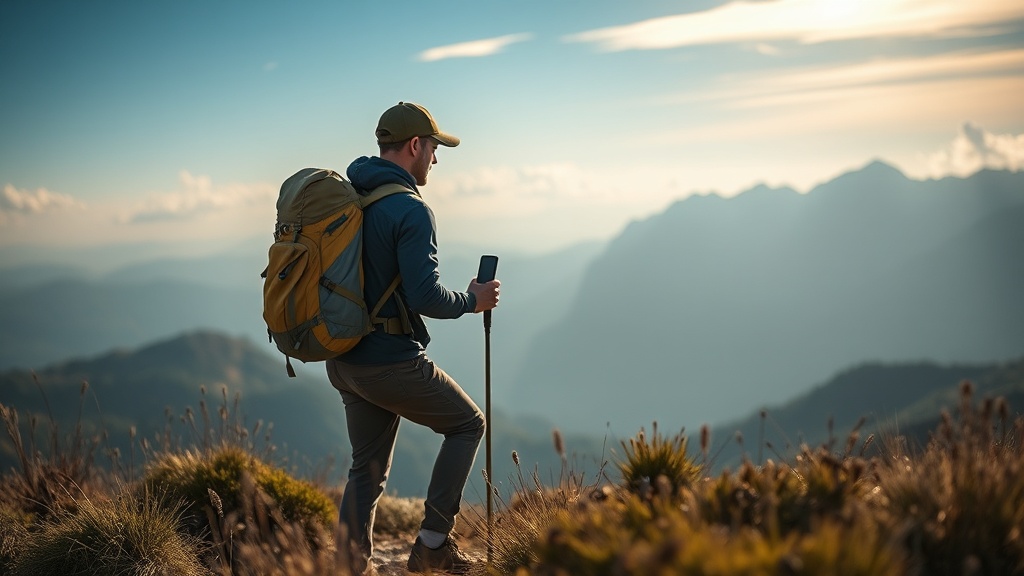
The Future of Smart Hiking: Is Wearable Tech Replacing the Compass?

I remember a Tuesday in the North Cascades about four years ago. I was working a standard 9-to-5 as an industrial designer, and I had just picked up a top-of-the-line multisport GPS watch. It was sleek, the screen was vibrant, and the marketing promised "unrivaled precision." Three hours into a descent through heavy timber and increasing fog, the battery hit 15%, the GPS signal drifted by forty meters, and the "smart" features became nothing more than a glowing, useless paperweight on my wrist. I had to pull a battered, analog Silva compass out of my pack to find my way back to the trailhead.
That day changed how I view "smart" gear. Now that I spend my life out of a van, testing equipment in the environments where failure isn't just an inconvenience but a safety risk, I look at wearable tech through a different lens. We are currently witnessing a massive shift in the outdoor industry. The question isn't just whether we should use smartwatches or biometric sensors, but whether we are trading fundamental survival skills for digital convenience. Is wearable tech actually replacing the compass, or is it just adding a layer of fragile complexity to our kits?
The Allure of the Data-Driven Hiker
The modern hiker is increasingly obsessed with metrics. We want to know our VO2 max, our recovery time, our elevation gain, and our real-time heart rate variability. This data is incredibly valuable for training and long-term health optimization. For instance, if you are looking to optimize your physiological recovery during seasonal transitions, understanding how your body reacts to environmental shifts is key—much like learning about syncing your circadian rhythm for better bio-harmony. The data provided by a Garmin Fenix or an Apple Watch Ultra can offer insights that were once the domain of professional athletes.
From a design perspective, the integration of sensors is a marvel. We are seeing advancements in blood oxygen monitoring, skin temperature tracking, and even advanced topographical mapping directly on the wrist. This level of information density allows a hiker to manage their exertion levels more effectively, preventing burnout and injury. However, as a former Search and Rescue (SAR) volunteer, I see a dangerous trend: the "Black Box" mentality. This is when a user trusts the device implicitly, assuming that if the screen says they are on the correct bearing, they are safe.
The Reliability Gap: Digital vs. Analog
To understand why a compass remains the gold standard, we have to look at the failure points of digital hardware. A digital device relies on a complex stack of dependencies:
- Battery Life: Even the best lithium-ion batteries have a ceiling. In cold weather, that ceiling drops precipitously.
- Signal Integrity: GPS relies on a line-of-sight to satellites. In deep canyons or under heavy canopy, that signal can bounce or vanish entirely.
- Hardware Fragility: A screen can crack, a charging port can fill with silt, or a software bug can freeze a device mid-navigation.
- The Human Element: A device requires a user to interact with it. If you are exhausted, cold, or injured, the last thing you want to do is navigate a complex touchscreen menu.
Contrast this with a high-quality baseplate compass. It requires zero power, has no moving parts that can "crash," and provides immediate, intuitive directional data. It is the ultimate low-cost-per-mile tool because its lifespan is measured in decades, not upgrade cycles. When I evaluate gear, I don't just look at the MSRP; I look at the reliability-per-mile. A $500 smartwatch that dies after two years of heavy use has a much higher cost-per-mile than a $30 compass that works every single time you pull it out of your pocket.
The Case for Smart Integration: When Tech Wins
I am not a Luddite. I am an industrial designer who appreciates good engineering. There are legitimate scenarios where wearable tech outperforms traditional methods. For example, real-time elevation tracking and pace management can be crucial for high-altitude mountaineering where managing oxygen consumption is a matter of life and death. Similarly, the ability to receive emergency SOS alerts via satellite connectivity on modern devices is a massive leap forward in backcountry safety.
The real value of smart tech lies in its ability to act as a secondary layer of information. If you are using a smartphone as a secondary navigation tool, you must be diligent about power management. I often recommend reading up on how to extend your smartphone battery life to ensure your digital maps don't go dark right when the trail gets technical. The goal should be a tiered system: use the high-tech tools for optimization and the low-tech tools for survival.
The Hierarchy of Navigation
If you want to build a kit that balances modern efficiency with old-school reliability, I suggest following this hierarchy of navigation tools:
- Primary (The Brain): A physical topographic map and a high-quality magnetic compass. This is your baseline.
- Secondary (The Optimizer): A dedicated GPS device or a high-end smartwatch. Use this for real-time tracking, pace, and precise waypoint navigation.
- Tertiary (The Backup): A smartphone with offline maps (like Gaia GPS or AllTrails). This is useful, but treat it as a temporary tool due to battery and signal vulnerabilities.
The Hidden Cost of "Smart" Living
There is a subtle psychological shift happening in the outdoor community. We are becoming more reliant on "the screen" and less reliant on "the terrain." When you are staring at a digital breadcrumb trail on a watch face, you aren't looking at the shape of the ridge, the way the drainage flows, or the subtle changes in vegetation that indicate a change in elevation. You are essentially playing a video game in the woods.
This detachment from the environment can lead to a lack of situational awareness. In my SAR days, I saw countless people who were "lost" despite having a working GPS. They were lost because they weren't actually *reading* the landscape; they were just following a blue dot. This is a failure of skill, not a failure of technology. If you don't know how to orient a map to the physical world, the most expensive Garmin in the world won't save you when the battery dies.
This dependency extends beyond the trail. We see it in how we manage our homes and our lives—constantly seeking the next layer of digital control. Whether it's centralizing your smart home ecosystem or managing a complex digital workflow, the lure of seamless automation is strong. But in the backcountry, seamlessness is a myth. The wild is inherently un-seamless, un-automated, and unpredictable.
Actionable Advice: Building Your Smart/Analog Hybrid Kit
As you decide whether to invest in the latest wearable tech, ask yourself these three questions to determine the true value of the gear:
- What is the failure mode? If this device fails, what is my immediate backup? If your answer is "I don't have one," you haven't finished building your kit.
- Does it provide actionable data or just more data? A heart rate monitor is actionable; a "social media integration" on a hiking watch is useless noise.
- Can I use it without a signal? Never rely on a device that requires a cloud connection to function in the field.
If you are looking to move toward a more sustainable, long-term approach to gear—both in your home and on the trail—I highly recommend looking into outdoor living practices for a greener spring. This mindset of longevity and respect for the environment naturally extends to your gear. Instead of buying a new "smart" gadget every season, invest in high-quality, analog tools that will last a lifetime.
Final Verdict
Is wearable tech replacing the compass? In the minds of many hobbyists, yes. In the reality of the backcountry, no. A smartwatch is a fantastic coach, a brilliant data logger, and a helpful secondary navigator. But it is a tool of optimization, not a tool of foundation.
Don't let the shiny UI of a new gadget distract you from the fundamental skills of land navigation. Use the tech to push your limits, to understand your body, and to refine your performance. But when the clouds roll in and the battery icon turns red, make sure you have a piece of plastic and a magnetized needle in your pocket that will still point North.